Artwork Notes · Preface to the Orchid Pavilion Collection (兰亭集序)
6/11/20265 min leer
Artwork Details
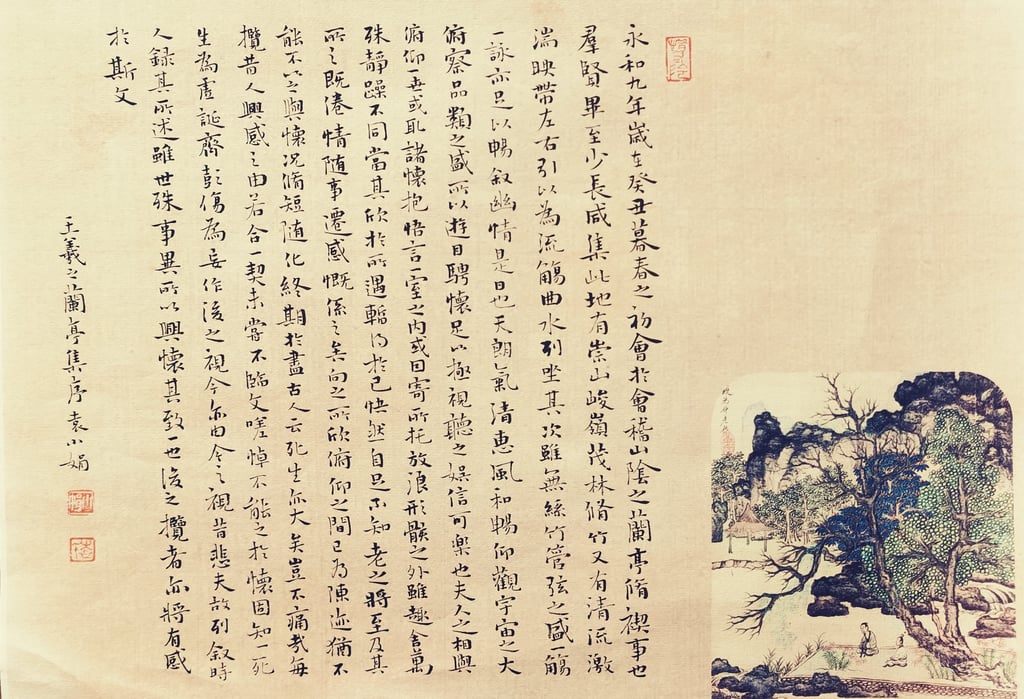
TitlePreface to the Orchid Pavilion Collection (兰亭集序, Lántíng Jí Xù)CalligrapherYuan XiaojuanOriginal authorWang Xizhi (Wang Hsi-chih), Eastern Jin dynasty, 303–361 CEScript styleRunning script (行书, xíngshū)PaperCream-white xuan paperSealsTwo red name seals (left, beside signature); one collector's seal (upper right)Accompanying paintingClassical landscape of the Orchid Pavilion gathering, right panel
The Text in Full
In the ninth year of the Yonghe reign, the year of Guichou, at the beginning of late spring, we gathered at the Orchid Pavilion in Shanyin of Kuaiji for the ritual purification. All the worthies came together, young and old alike. The site was graced with towering mountains and steep ridges, dense forests and tall bamboo; and there was a clear, rushing stream that wound around, to the left and right of us. We directed it to flow as a winding water-course for floating wine cups, and took our seats along its banks. Though we lacked the elaborate sounds of strings and woodwinds, a cup of wine and a poem were more than enough to give free expression to our innermost feelings.
On that day the sky was clear, the air fresh, and a gentle wind mild and pleasant. Looking up, we observed the vastness of the universe; looking down, we saw the abundance of all creation. Letting our eyes wander and our hearts roam freely, we had enough to exhaust the pleasures of sight and sound. It was truly a joy.
Now when people come together in this life, some spend it indoors, confiding their inmost thoughts; others give free rein to their impulses, casting off all restraint. Although their inclinations differ — some quiet, some restless — when each finds pleasure in what he encounters and is momentarily satisfied, not a thought is given to growing old. Yet when weariness follows on delight, and feelings shift as circumstances change, regret cannot but arise. What delighted us before has become, in the mere space of a glance, an old trace — and we cannot help but feel moved by it. Still more so when our allotted span of life is subject to nature, and must finally reach its end. The ancients said: "Death and life are indeed great matters." Is that not cause for grief?
Whenever I consider what moved people of old to feel as they did, it is as though I find a perfect match with myself. I have never read their writings without lamenting at the words, unable to explain it in my heart. I know well that it is nonsense to equate life and death; it is a fiction to say that long life and early death are the same. Those who come after us will look back on us as we look back on those who came before. How sad. And so I have listed the people present and recorded what they wrote. Though times and circumstances will change, the things that stir our hearts are the same. Future readers will, in their turn, find something to feel in these words.
Colophon: Text of Wang Xizhi · Preface to the Orchid Pavilion Collection · Yuan Xiaojuan
Three Layers of Meaning
The preface is only three hundred and twenty-four characters long. Yet within that brevity, Wang Xizhi moves through three distinct emotional registers — and it is this movement that has made the text unrepeatable.
The first layer: joy
In 353 CE, on the third day of the third lunar month, Wang Xizhi and forty other scholars gathered at the Orchid Pavilion in what is now Shaoxing, Zhejiang Province, for a ritual spring purification. They sat along a winding stream, floated wine cups on the current, and whoever the cup drifted toward had to compose a poem or drink a forfeit. The mountains were high, the bamboo dense, the sky clear, the wind soft. Wang Xizhi writes: "It was truly a joy." Simple, unhurried, complete. No excess.
The second layer: grief
Then the tone turns. Life, Wang Xizhi reflects, passes in the time it takes to glance up and glance down. The things that delighted us become, in an instant, old traces. We cannot outwit time; long life or short, everything ends. "Death and life are indeed great matters. Is that not cause for grief?" This is not despair — it is the honest recognition of what it means to be alive.
The third layer: sorrow tinged with understanding
In the final movement, Wang Xizhi refuses the consolations that others offered: that life and death are equivalent, that all time is the same. He insists on the weight of each specific moment. And he turns to us, the future readers: "Though times and circumstances will change, the things that stir our hearts are the same. Future readers will, in their turn, find something to feel in these words." He was right. Sixteen centuries later, we still do.
Wang Xizhi and the Original Manuscript
Wang Xizhi (303–361 CE), courtesy name Yishao, is the most revered calligrapher in Chinese history — known simply as the Sage of Calligraphy (书圣). He brought the running script to its highest form, combining structural elegance with natural spontaneity.
The original Preface to the Orchid Pavilion was written in a single sitting, reportedly after Wang Xizhi had drunk some wine and was in a state of exhilarated ease. The next day, completely sober, he tried many times to surpass or even equal it — and could not. That manuscript became the most celebrated piece of calligraphy in Chinese history.
The Tang dynasty Emperor Taizong (598–649 CE) was so devoted to this work that he reportedly had it buried with him in his tomb when he died. The original has been lost to the world ever since. What survives are copies made by Tang dynasty masters, and the countless generations of calligraphers who have studied and transcribed this text ever since — not only to perfect their brushwork, but as an act of communion with one of the defining expressions of the human condition in Chinese culture.
About the Script: Running Script (行书)
Running script occupies a unique place in the Chinese calligraphic tradition — it is neither the rigorous discipline of regular script nor the wild freedom of cursive. It moves. It breathes. It is considered the most natural mode of expression for the educated brush.
The choice of running script for this text is deliberate and deeply fitting. Wang Xizhi himself wrote the original Orchid Pavilion Preface in running script — it is, in fact, the most famous running script work in existence. To write this text in any other style would be to misread its nature.
Examining Yuan Xiaojuan's work closely:
Brushwork: The strokes show controlled variation between strong and light, with natural ink gradation from saturated to slightly dry — a sign of skilled, uninterrupted concentration.
Composition: Characters vary in size and spacing in a way that feels organic rather than mechanical. Dense passages alternate with open ones; the eye moves naturally across the page.
Rhythm: The piece builds as it goes. The later sections, dealing with grief and mortality, carry a slightly greater urgency in the brushwork — as though the calligrapher's own feeling is threading itself through the original text.
The Accompanying Painting
The right panel presents a classical landscape depiction of the Orchid Pavilion gathering: towering pines, layered mountains, a winding stream, and scholars seated in quiet contemplation along the bank. A pavilion stands among the trees.
This format — calligraphy and painting presented side by side — represents the highest traditional form of Chinese scroll composition, known informally as "the four perfections": poetry, calligraphy, painting, and seal. Each element complements the others; together they form a complete world on paper.
For the Collector
No text has been more copied, more studied, or more meditated upon in the Chinese calligraphic tradition than the Preface to the Orchid Pavilion. For sixteen centuries, calligraphers have returned to it not only as a technical exercise but as a way of confronting what Wang Xizhi confronted: the beauty of a particular afternoon, the irreversibility of time, and the strange consolation of knowing that others — before us and after us — have felt exactly the same way.
Yuan Xiaojuan brings her own trained hand and her own interior life to this text. The brushwork is hers; the feeling, though first written sixteen centuries ago, belongs to anyone who reads it.
Hang this piece in a room you spend time in. Let it age with you. It has that kind of patience.
Yuan Xiaojuan is an official member of the China Calligraphers Association and President of the Weihai Calligraphers Association. This is an original work, hand-brushed on traditional xuan paper with natural ink, bearing the calligrapher's personal seals. One of a kind.
Brand
Explore our sleek website template for seamless navigation.
Contact
Newsletter
© 2024. All rights reserved.
Términos y Condiciones