Artwork Notes · Four Song Dynasty Ci Poems (宋词四首)
6/15/20266 min read
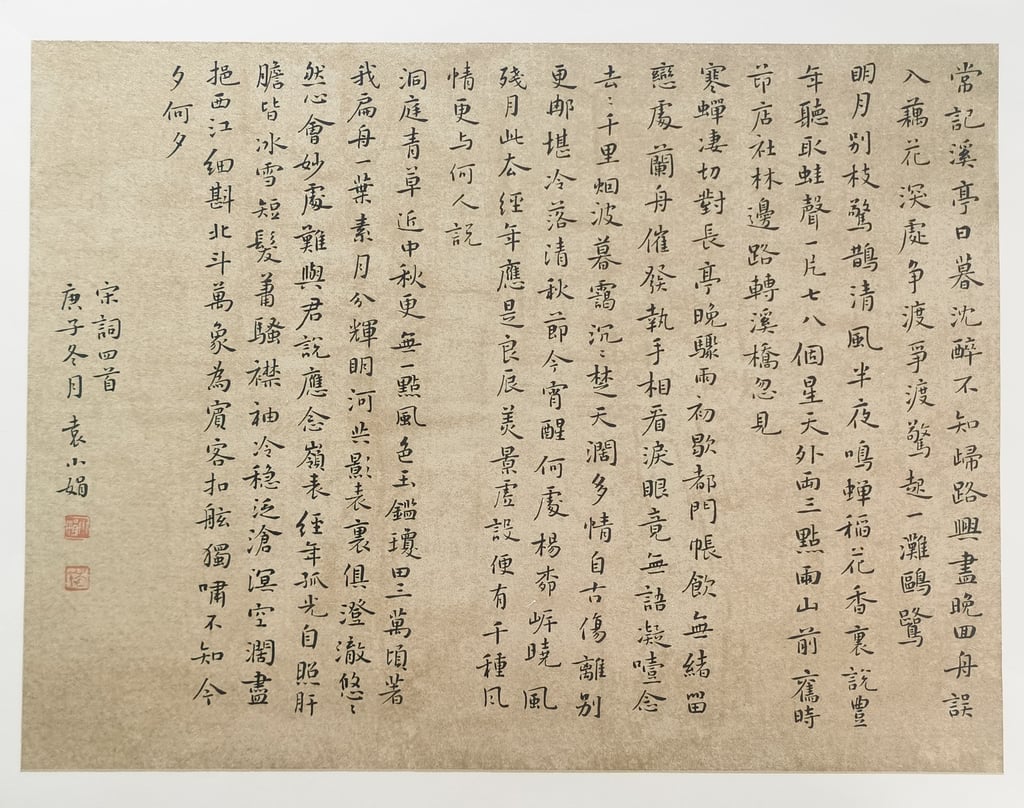
Artwork Details
Title
Four Song Dynasty Ci Poems (宋词四首)Calligrapher
Yuan XiaojuanScript style
Running-regular script (行楷, xíngkǎi)Dated
Winter of the Gengzi year (winter 2020)Paper
Antique brown xuan paper
Seals
Two red name seals (at the signature)Content
One ci poem each by Li Qingzhao, Xin Qiji, Liu Yong, and Zhang Xiaoxiang
The Four Poems
This work brings together four representative ci poems by four different Song dynasty poets, in four different styles — together spanning the most important emotional registers of the entire ci tradition.
First · Li Qingzhao, "Like a Dream" (如梦令)
I often recall the pavilion by the stream at dusk, / so lost in wine I could not find my way home. / My pleasure spent, I turned my boat back late, / and drifted by mistake deep among the lotus blooms. / Push through, push through! — / and startled into flight a whole shoal of herons and gulls.
Appreciation: A famous work from Li Qingzhao's girlhood, recalling the joy of an outing. Dusk at a streamside pavilion, a pleasant tipsiness, a boat drifting by mistake into the lotuses, and in the flurry a flock of waterbirds rising into the air — in a handful of lines, the poem captures the carefree innocence of youth. Fresh and natural in language, it is one of the most beloved works of the "delicate and restrained" school.
Second · Xin Qiji, "The Moon over the West River: Night Journey on the Yellow Sand Road" (西江月·夜行黄沙道中)
The bright moon leaves the branch, startling the magpies; / a clear wind at midnight, the cicadas singing. / Amid the fragrance of rice flowers, talk of a good harvest year, / and listen — a chorus of frogs. / Seven or eight stars beyond the sky, / two or three raindrops before the hills. / The old thatched inn by the trees of the shrine — / the road turns past the stream-bridge, and suddenly there it is.
Appreciation: Xin Qiji's poem describes a summer night's walk through the countryside — a masterpiece of the Chinese pastoral ci. The bright moon, startled magpies, clear wind, singing cicadas, rice fragrance, and frog-song are all ordinary rural sights and sounds, yet arranged into something fresh and moving. The second stanza, with its scattered stars, light rain, and the inn that appears unexpectedly, is full of quiet delight. The joy of a harvest in prospect and the serenity of rural beauty come vividly to life.
Third · Liu Yong, "Bells in the Rain: The Cold Cicadas Cry" (雨霖铃·寒蝉凄切)
The cold cicadas cry desolately; / facing the wayside pavilion at evening, / the sudden rain has just ceased. / At the city gate, drinking without spirit in the farewell tent, / lingering reluctantly — / yet the magnolia boat urges us to set off. / Hands clasped, we gaze through tear-filled eyes, / and in the end no words come, only choked silence. / I think of the going, the going — a thousand miles of misted waves, / the evening haze hanging heavy over the vast southern sky. / Those who feel deeply have grieved at parting since ancient times — / how much more, in the cold desolation of clear autumn! / Where shall I be tonight when the wine wears off? / By the willow bank, in the dawn wind and the waning moon. / This going will last for years; / surely all the fair days and lovely scenes will be set out in vain. / And though I should have a thousand tender feelings, / to whom now could I ever speak them?
Appreciation: This is the most famous poem of parting in all of Chinese literature, and Liu Yong's signature work. It opens with the desolation of cold cicadas, the wayside pavilion, and a sudden rain, then describes the wordless pain of lovers parting — "hands clasped, we gaze through tear-filled eyes, and in the end no words come, only choked silence." The line "Where shall I be tonight when the wine wears off? By the willow bank, in the dawn wind and the waning moon" is among the most celebrated in the language, capturing the loneliness after parting to its very depths. The tender melancholy of the "delicate and restrained" school reaches its summit here.
Fourth · Zhang Xiaoxiang, "Charm of a Maiden Singer: Crossing Lake Dongting" (念奴娇·过洞庭)
Lake Dongting and Green Grass Lake, / near the Mid-Autumn — and not a breath of wind. / Three myriad acres of jade mirror and jewelled field, / and on it, my single leaf of a boat. / The pure moon shares its light, / the bright River of Heaven shares its reflection — / within and without, all is utterly clear. / Serenely my heart understands; / the wonder of it I can hardly tell you. / I think of my years beyond the mountain passes — / my solitary light shining on itself, / heart and soul pure as ice and snow. / My thinning hair windblown, my robes and sleeves cold, / I float steady on the boundless dark sea. / Ladling up the whole West River, / pouring slow cups by the Northern Dipper, / I make all creation my guests. / Drumming on the gunwale, I cry out alone — / no longer knowing what night this night may be.
Appreciation: Zhang Xiaoxiang's poem is grand in scale, a masterpiece of the "bold and unrestrained" school. The poet drifts in a boat on Lake Dongting at Mid-Autumn; the lake is windless, moonlight and the Milky Way reflecting upon one another, water and sky a single clarity. Within this vast expanse of heaven and earth, the poet feels a purity and openness "pure as ice and snow." The closing — "Ladling up the whole West River, pouring slow cups by the Northern Dipper, I make all creation my guests" — takes the West River for wine, the Big Dipper for a ladle, and invites all things in the universe as guests. What breadth of spirit, what magnificence of vision!
Cultural Background: Song Ci and the Two Schools
Song ci stands alongside Tang poetry as one of the twin peaks of Chinese classical literature, and is the most representative literary form of the Song dynasty (960–1279 CE). Ci were originally lyrics set to music, composed to fixed melodic patterns known as cipai (tune titles — "Like a Dream" and "Bells in the Rain" are both such titles).
Song ci is broadly divided into two stylistic schools:
The delicate and restrained school (婉约派) — represented by Li Qingzhao and Liu Yong — is intimate and tender, often writing of parting sorrows and the feelings of the heart, in language subtle and refined. "Like a Dream" and "Bells in the Rain" in this work belong to this school.
The bold and unrestrained school (豪放派) — represented by Su Shi, Xin Qiji, and Zhang Xiaoxiang — is powerful and expansive, often writing of love of country and the grand passions of life, on a magnificent scale. "The Moon over the West River" and "Crossing Lake Dongting" belong to this school.
This work skilfully places the two schools side by side — the girlish innocence of Li Qingzhao and the tender grief of Liu Yong, together with the pastoral freshness of Xin Qiji and the cosmic grandeur of Zhang Xiaoxiang. Four poems, four states of mind — a miniature portrait of the whole world of Song ci.
About the Script: The Elegance of Running-Regular Script
This work is written in running-regular script (行楷, xíngkǎi) — a style between the orderliness of regular script and the fluency of running script. It preserves the upright clarity of each character while carrying a natural rhythm of the brush; it is the ideal style for combining legibility with artistry.
For transcribing long poems, running-regular script is an excellent choice: neither as constrained as pure regular script, nor as hard to read as cursive, it allows the reader to follow the brush and savour each poem at leisure.
Looking closely at this work:
Brushwork: The strokes are fluent and natural, alive within their orderliness, with occasional connecting threads between strokes; the overall rhythm is unhurried and composed.
Composition: Arranged in vertical columns, the four poems transcribed in sequence, with even spacing and well-judged density — flowing and abundant, yet perfectly ordered, a demonstration of the calligrapher's command of long-form content.
Spirit: The antique brown xuan paper lends the whole work an air of aged refinement, ink and paper complementing one another like a scroll of hand-copied ci poetry stepped out of history.
For the Collector
Song ci is among the classical literature most familiar to and most beloved by the Chinese people. Lines such as "I often recall the pavilion by the stream at dusk" and "Where shall I be tonight when the wine wears off? By the willow bank, in the dawn wind and the waning moon" are known to nearly everyone in China. A scroll of Four Song Ci Poems carries one of the loveliest chapters of Chinese literary memory.
The value of this work lies on three levels:
Literary — within a single scroll it gathers four great masters — Li Qingzhao, Xin Qiji, Liu Yong, and Zhang Xiaoxiang — the delicate and the bold side by side; a weighty cultural distillation of the finest of Song ci; Calligraphic — transcribing long-form poetry in running-regular script tests both the strength of the brush and the command of overall composition, a work of both difficulty and beauty; Emotional — the four poems span four flavours of life: youth, the pastoral, parting, and heroic spirit; whatever stage of life the viewer is in, they will find something to resonate with.
Hang this work in your home, and the four poems on the wall become four windows onto the Song dynasty: from a young girl's lotus pond at dusk, to a pair of lovers parting in tears at the wayside pavilion; from a rice-scented village on a summer night, to the boundless heaven and earth of Lake Dongting at Mid-Autumn. Each time you read them, it is a journey of the heart across a thousand years.
Yuan Xiaojuan is an official member of the China Calligraphers Association and President of the Weihai Calligraphers Association. This is an original work, hand-brushed on traditional xuan paper with natural ink, bearing the calligrapher's personal seals. One of a kind.
Brand
Explore our sleek website template for seamless navigation.
Contact
Newsletter
© 2024. All rights reserved.
Terms and Conditions