Artwork Notes · Record of the Little Stone Pond (小石潭记)
6/15/2026
Artwork Details
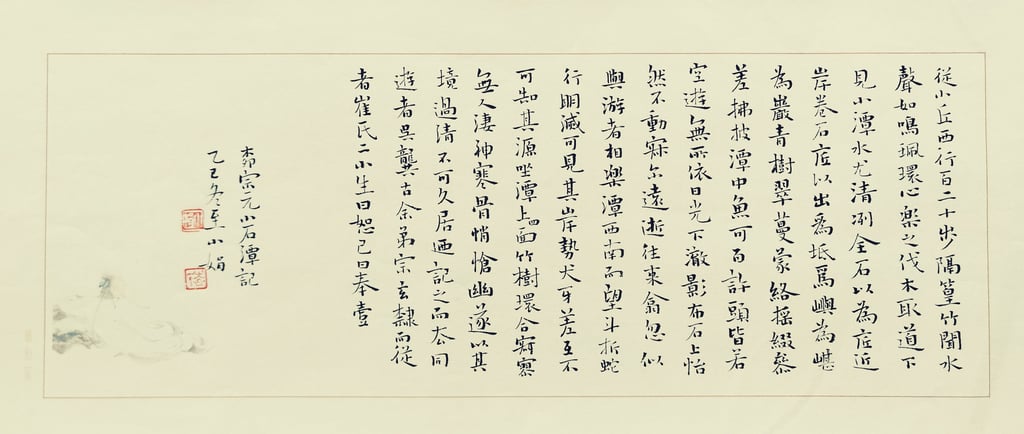
Title Record of the Little Stone Pond (小石潭记, Xiǎo Shí Tán Jì)
Calligrapher Yuan Xiaojuan
Original author Liu Zongyuan (Liu Tsung-yüan), Tang dynasty, 773–819 CE
Script style Small regular script (小楷, xiǎokǎi)
Dated Winter of the Yisi year (winter 2025)
Paper Cream-white xuan paper
Seals Two red name seals (at the signature)
Accompanying painting A light-ink landscape vignette, lower left
The Text in Full
Walking westward from the small hill for one hundred and twenty paces, beyond a screen of bamboo, I heard the sound of water — like the chiming of jade pendants — and my heart was glad. Cutting through the bamboo to make a path, I came upon a small pond below, its water exceptionally clear and cold. A single slab of stone formed its bed, and near the bank the stone curled up out of the water to form shoals, islets, ridges, and crags. Green trees and emerald vines covered and entwined it, swaying and trailing, scattered and waving in the breeze.
In the pond were perhaps a hundred fish, all seeming to float in empty air with nothing to support them. Sunlight reached down to the bottom, casting their shadows upon the stones, where they hung motionless and content; then suddenly they darted away into the distance, coming and going in quick flashes, as if sharing in the joy of the visitor.
Looking to the southwest of the pond, the stream wound like the handle of the Dipper, like a snake in motion, now visible, now hidden. The shape of its banks interlocked like a dog's teeth, and one could not tell where its source lay.
Sitting above the pond, surrounded on all four sides by bamboo and trees, in silence and solitude, I felt a chill that pierced spirit and bone, a desolate and profound melancholy. Because the place was too cold and still to remain in for long, I recorded it and departed.
Those who travelled with me: Wu Wuling, Gong Gu, and my younger brother Zongxuan. Following as attendants were two young men of the Cui family: one named Shuji, the other named Fengyi.
Colophon: "Record of the Little Stone Pond" by Liu Zongyuan · Winter of the Yisi year · Yuan Xiaojuan
Reading the Text
The Record of the Little Stone Pond is the most famous of the "Eight Records of Yongzhou", written by Liu Zongyuan during his political exile. Fewer than two hundred characters long, it is regarded as one of the highest achievements of the Chinese landscape essay.
The essay unfolds as a journey, scene by scene:
The discovery — Drawn by the sound of water, clear as chiming jade, the writer cuts a path through the bamboo and finds a small pond, its water cold and perfectly clear. A single slab of stone forms the bed; near the shore it curls up into islets and crags, draped in green trees and trailing vines.
The fish — This is the passage for which the essay is most celebrated. Around a hundred fish appear to hang suspended in empty air, supported by nothing. Sunlight pierces to the bottom, casting their shadows on the stone, where they hold still — then suddenly dart away, quick and weightless, as though playing with the visitor. In this entire passage, the word "water" never appears once — and yet every line is water. This is the supreme art of Chinese classical prose: to render a thing most fully by never naming it.
The source — Looking southwest, the stream twists like the handle of the Big Dipper, winds like a snake, appearing and vanishing. The banks interlock like a dog's teeth, and the source cannot be found.
The feeling — Sitting by the pond, encircled by bamboo and trees, in complete silence, the writer feels "a chill that pierces spirit and bone, a desolate and profound melancholy". The place is too cold and still to stay in; so he records it, and leaves.
The final lines name each of his companions — a traditional convention of the Chinese travel essay, and a quiet reminder that this solitary scene was, after all, shared by living people.
The Story Behind the Text: Liu Zongyuan in Exile
Liu Zongyuan (773–819 CE), courtesy name Zihou, was one of the great writers and thinkers of the Tang dynasty — one of the "Eight Masters of the Tang and Song", and, with Han Yu, a leader of the Classical Prose Movement.
In 805 CE, following the failure of a political reform he had joined, Liu Zongyuan was banished to the remote prefecture of Yongzhou (in present-day Hunan Province), where he would remain for ten years. It was the darkest period of his life — and the most luminous of his literary career. The "Eight Records of Yongzhou" were written during this time.
On its surface, the Record of the Little Stone Pond describes a landscape. In truth, it describes a state of mind. That cold, beautiful, unvisited pond is Liu Zongyuan himself — exiled, forgotten, alone. A clear and lovely pool that no one comes to see, and a brilliant writer cast aside in the wilderness, quietly merge within the text. This technique — writing the inner life through the outer landscape, hiding sorrow within beauty — is what makes the essay so enduringly moving.
About the Script: The Stillness of Small Regular Script
This work is written in small regular script (小楷, xiǎokǎi), the style that most rigorously tests a calligrapher's skill and patience.
The characters are tiny, each stroke completed with precision within a space barely larger than a fingernail. There is none of the sweeping freedom of large characters here — only steady control of the wrist and a focused, quiet mind. To sustain consistency of stroke and continuity of breath across nearly two hundred small characters, from the first to the last, is itself a discipline of concentration.
Looking closely at this work:
Brushwork: Each dot and stroke is exact, with clear beginnings and endings. The horizontals and verticals show firm command of form, while subtle shifts of pressure keep the writing alive rather than mechanical.
Composition: The text is arranged in even vertical columns, each character independent yet connected in spirit. The result is spacious, clear, and refined — perfectly attuned to the cold, still atmosphere of the essay.
Spirit: Small regular script prizes "stillness" above all. This work carries a quality of calm, restraint, and quiet reserve — much like the lonely pond of Liu Zongyuan's text: silent, yet possessed of real strength.
The Accompanying Painting
In the lower left corner is a light-ink landscape vignette: a few sparse strokes suggesting distant hills and a stretch of water, the ink pale, the mood weightless and clear.
This use of generous empty space mirrors the essay's central feeling of "silence and solitude" — the emptiness in the painting is the stillness in the words. Calligraphy, painting, and meaning achieve a threefold unity within a single work.
For the Collector
The Record of the Little Stone Pond is a cornerstone of the Chinese literary canon — a text studied by nearly every schoolchild in China, recited in youth and remembered for life. What it carries is not only a passage of beautiful landscape writing, but a particular spirit of the Chinese literati: the capacity, at the lowest point of one's life, to write the most beautiful scenery with the clearest brush.
The value of this work lies on three levels:
Literary — a celebrated essay known across more than a thousand years, of the highest cultural recognition; Calligraphic — small regular script is the most demanding of styles, unforgiving and impossible to rush, a true demonstration of deep traditional mastery; Emotional — it tells an eternal story of adversity and beauty, solitude and quiet endurance, a feeling that transcends both era and language.
Hang this work in your home, and the nearly two hundred small characters on the wall will quietly tell of an afternoon twelve hundred years ago: an exiled scholar who found a clear pond in the wilderness, and fixed forever on paper the beauty and the loneliness of that single moment.
Yuan Xiaojuan is an official member of the China Calligraphers Association and President of the Weihai Calligraphers Association. This is an original work, hand-brushed on traditional xuan paper with natural ink, bearing the calligrapher's personal seals. One of a kind.
Brand
Explore our sleek website template for seamless navigation.
Contact
Newsletter
© 2024. All rights reserved.
Terms and Conditions