Artwork Notes · The Diamond Sutra, Chapter 25 (金刚经·化无所化分)
6/15/2026
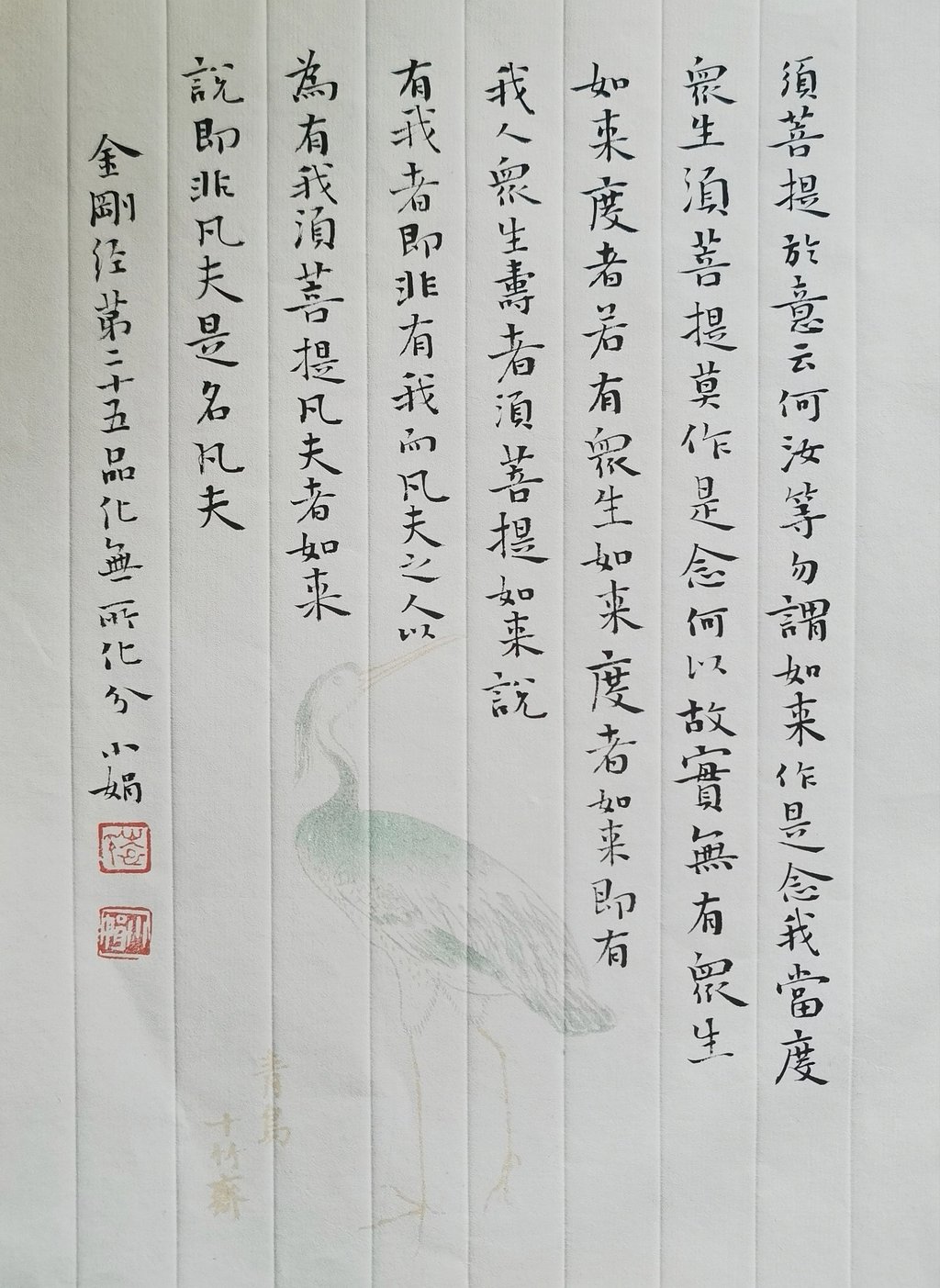
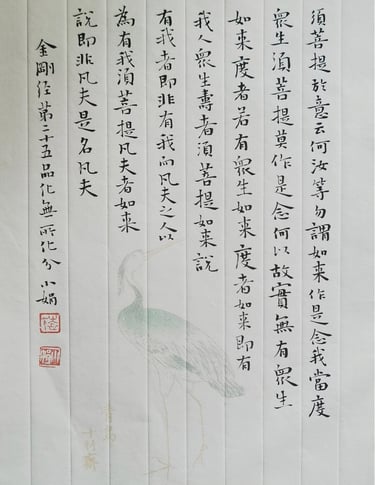
Artwork Details
Title
The Diamond Sutra, Chapter 25: "Transforming the Unconvertible" (化无所化分)Calligrapher
Yuan XiaojuanSource text
The Diamond Sutra (Vajracchedikā Prajñāpāramitā Sūtra), Kumārajīva translationScript style
Regular script (楷书, kǎishū)Paper
Cream-white gold-flecked letter paperSeals
Two red name seals (at the signature)Accompanying painting
A single crane in soft colour, standing elegantly on the page
The Text in Full
"Subhuti, what do you think? You must not say that the Tathagata holds the thought, 'I shall liberate sentient beings.' Subhuti, do not think in this way. And why? In truth there are no sentient beings for the Tathagata to liberate. If there were sentient beings for the Tathagata to liberate, then the Tathagata would hold to the notions of a self, a person, a being, and a life-span. Subhuti, when the Tathagata speaks of 'a self', there is in fact no self — yet ordinary people take it to be a self. Subhuti, as for 'ordinary people', the Tathagata says they are not ordinary people; that is merely what they are called."
Colophon: The Diamond Sutra, Chapter 25, "Transforming the Unconvertible" · Yuan Xiaojuan Paper mark: Shizhuzhai Studio, Qingdao
Reading the Text
This is the twenty-fifth chapter of the Diamond Sutra, titled "Transforming the Unconvertible". In just a few dozen characters, it expresses one of the most central — and most difficult — insights of Buddhist wisdom.
The Buddha speaks to his disciple Subhuti:
First layer — dissolving the thought "I liberate beings" Do not imagine that the Tathagata (the Buddha) holds the thought, "I ought to liberate sentient beings." Why? Because in truth, there is no "sentient being" being liberated by the Tathagata at all.
Second layer — dissolving the notion of "self" If the Tathagata truly believed that beings were being liberated by him, then he would still be holding to the four attachments: the notions of self, person, being, and life-span. One who is truly awakened does not even hold the thought "I am liberating others" — for the moment a "self" appears, one has fallen back into discriminating mind.
Third layer — the paradox of "merely called" The final sentence is the most subtle of all: when the Buddha speaks of "ordinary people," there is no fixed, unchanging thing called an "ordinary person." It is only a convenient name, provisionally used.
This pattern — "it is not… it is merely called…" — is the most famous mode of thought in the Diamond Sutra. It first affirms a concept (ordinary people), then negates its inherent existence (not ordinary people), and finally returns to the practical use of the name (merely called ordinary people). It teaches the dissolution of all attachments — including attachment to the very concepts of "awakening," "liberation," and "self."
Cultural Background: The Diamond Sutra in Chinese Culture
The Diamond Sutra (full title: Vajracchedikā Prajñāpāramitā Sūtra) is one of the most important scriptures of Mahayana Buddhism, and the most widely circulated and deeply influential Buddhist text in China.
At its heart is the wisdom of "emptiness" (śūnyatā) — the dissolution of all attachment and discriminating thought, and the recognition that no phenomenon in the world possesses a fixed, unchanging essence. Its most celebrated lines are the closing verse: "All conditioned things are like a dream, an illusion, a bubble, a shadow; like dew, like lightning — thus should they be regarded."
After being translated by Kumārajīva in 402 CE, the Diamond Sutra profoundly shaped Chinese Chan (Zen) Buddhism. Huineng, the Sixth Patriarch of Chan, is said to have attained awakening upon hearing a single line from this sutra: "Let the mind arise without dwelling on anything." It is no exaggeration to say that this text shaped the Chinese understanding of "letting go," "impermanence," and "freedom of spirit," permeating Chinese philosophy, art, and daily life.
The Tradition of Copying Sutras In China, copying a Buddhist sutra by hand is regarded as a spiritual practice in itself — known as chaojing. It is not merely the reproduction of text, but a method of stilling the mind, cultivating concentration, and accumulating merit. Countless scholars and calligraphers throughout history have copied the Diamond Sutra, as both an expression of faith and a refinement of their art. By transcribing this sutra in careful regular script, Yuan Xiaojuan continues a tradition more than a thousand years old.
About the Script: The Stillness of Sutra Copying in Regular Script
This work is written in regular script (楷书, kǎishū), the most common and most reverent style for copying sutras.
Sutra copying is not about the display of individuality, but about reverence, concentration, and calm. Each character must be upright and exact, no stroke hurried or careless — because the copying itself is a practice of "cultivating the mind." The orderliness of the writing reflects the stillness of the heart.
Looking closely at this work:
Brushwork: The strokes are clear and clean, with measured beginnings and endings, and even, balanced structures. Not a single stroke is neglected — a reflection of the copyist's devotion and steadiness.
Composition: Arranged in vertical columns with spacious, even spacing and generous white space, the whole carries an atmosphere of purity, perfectly suited to the sutra's spirit of "clarity unstained."
Spirit: Sutra copying in regular script prizes one quality above all: reverence. This work radiates a sense of calm, dignity, and freedom from worldly dust — to look upon it is to feel the mind grow quiet.
The Accompanying Painting: The Crane
At the centre of the work, painted in soft colour, stands a single crane — elegant, poised, upright.
In Chinese culture, the crane is a symbol of longevity, purity, and transcendence, often associated with Daoist immortal realms and Buddhist serenity. The crane standing among the lines of scripture echoes the Diamond Sutra's spirit of "rising above the world, unstained by attachment" — the crane's solitary grace is precisely the spiritual state the practitioner aspires to.
The Paper This work is brushed on specially made gold-flecked letter paper from the Shizhuzhai Studio of Qingdao. Shizhuzhai is a celebrated name in Chinese decorative letter paper, with roots in the Ming dynasty Nanjing studio of the same name, renowned for its exquisite woodblock water-printed papers. The subtle patterning and faint gold add a note of refined antiquity and dignity to this transcription.
For the Collector
The Diamond Sutra is the most widely circulated Buddhist scripture in China — the very name carries immense cultural recognition and spiritual weight. A hand-copied Diamond Sutra holds not only the beauty of calligraphy, but a current of Eastern wisdom about "letting go" and inner freedom.
The value of this work lies on three levels:
Spiritual — it carries the Buddhist wisdom of "emptiness," an eternal reflection on dissolving attachment and returning to the original mind; a spirit that transcends religion and culture, and can stir something in anyone; Calligraphic — sutra copying in regular script is unforgiving and exacting, the truest test of skill and steadiness, a demonstration of deep traditional mastery and a reverent heart; Material — brushed on celebrated Shizhuzhai paper and graced with a softly coloured crane, it unites the four beauties of calligraphy, painting, paper, and seal — a rare treasure not easily found.
Hang this work in your home, and the passage of scripture on the wall becomes both an object of quiet beauty and a place of stillness. Whether or not you follow Buddhism, when your gaze rests on those upright characters and the poised crane, that sense of calm and transcendence will quietly flow into your heart.
Yuan Xiaojuan is an official member of the China Calligraphers Association and President of the Weihai Calligraphers Association. This is an original work, hand-brushed on fine artisan letter paper with natural ink, bearing the calligrapher's personal seals. One of a kind.
Brand
Explore our sleek website template for seamless navigation.
Contact
Newsletter
© 2024. All rights reserved.
Terms and Conditions