Artwork Notes · Three Chapters from the Tao Te Ching (道德经三章)
6/18/20267 min read
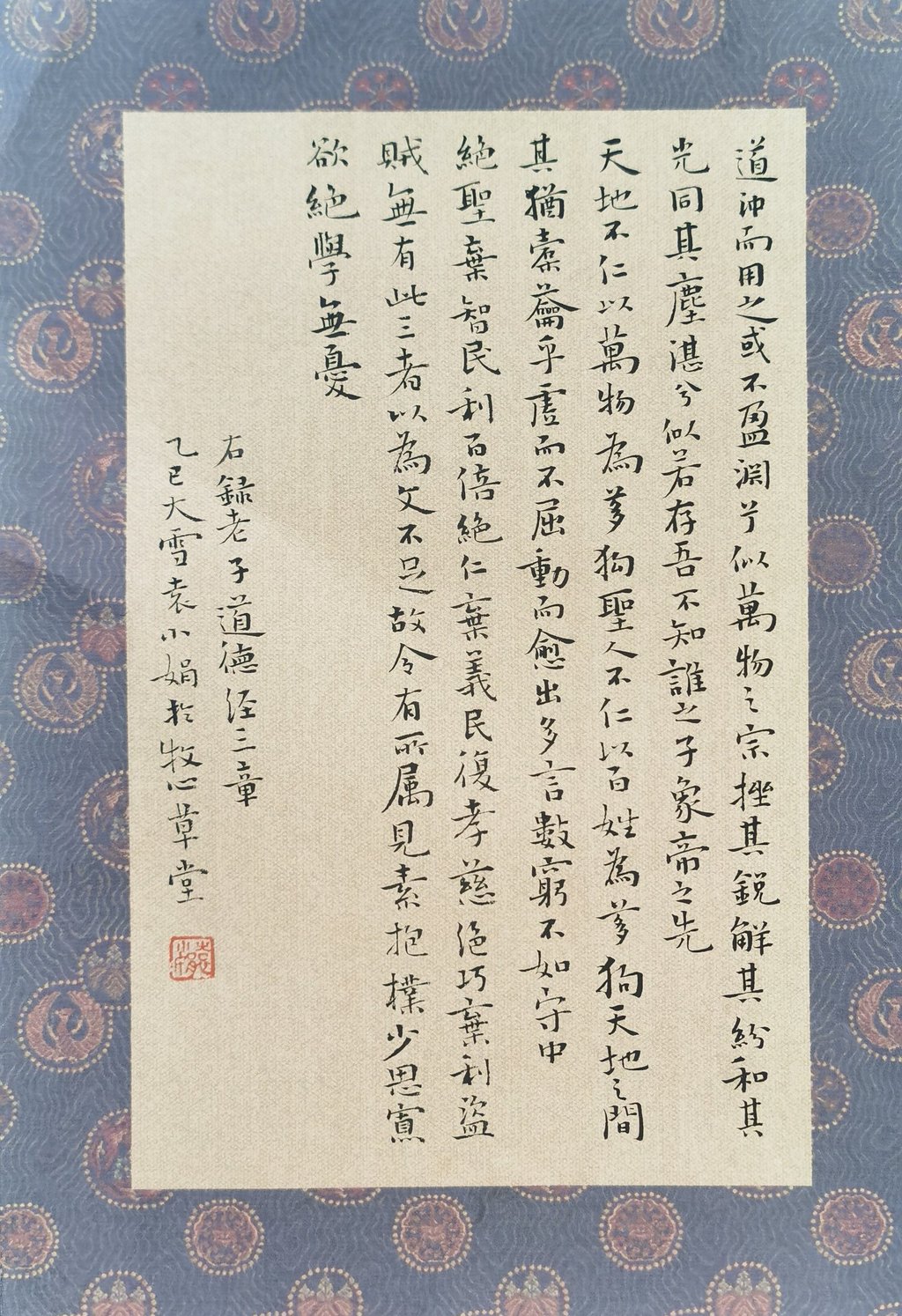
Artwork Details
Title
Three Chapters from the Tao Te Ching (道德经三章, Chapters 4, 5 and 19)
Calligrapher
Yuan Xiaojuan
Original author
Laozi (Lao Tzu), late Spring and Autumn period, c. 6th–4th century BCE
Script style
Running-regular script (行楷, xíngkǎi)
Dated
Major Snow of the Yisi year (around 7 December 2025)
Paper
Cream-white xuan paper
Seals
One red name seal (at the signature)
Studio
Muxin Caotang (牧心草堂, Shepherd's Heart Studio)
Cultural Background: The Tao Te Ching and Its Place in the World
The Tao Te Ching (also written Daodejing) consists of eighty-one short chapters and around five thousand Chinese characters — one of the most concise philosophical texts ever written, and one of the most widely translated books in the world, second only to the Bible in the number of languages into which it has been rendered.
Laozi (c. 571–471 BCE, dates disputed), traditionally described as the Keeper of the Royal Archives of the Zhou dynasty, is its reputed author. The text addresses the fundamental nature of the universe (Tao: the Way), the laws by which all things unfold, and how a human being can find their place within them.
The text's central concept, wuwei (无为), is often translated as "non-action" — but it means more precisely acting without forcing, yielding without grasping, moving with rather than against the nature of things. In contemporary terms, it speaks directly to the problem of anxiety, overextension, and the restless pursuit of more: the radical suggestion that less effort, not more, leads to a fuller life.
The tradition of copying sutras and classics In China, copying a canonical text by hand — whether a Buddhist sutra or a Taoist classic — has long been understood as a form of spiritual practice. Each stroke of the brush requires complete attention; there is no room for distraction. To copy three chapters of the Tao Te Ching is, in a very literal sense, to practise wuwei: to still the mind, steady the hand, and let the words arrive without force.
The Text in Full
Chapter 4
The Tao is empty — yet in use it is never exhausted. / Fathomless! It seems to be the ancestor of all things. / It blunts sharp edges, / unravels tangles, / softens glare, / merges with the dust. / Deep and still! It seems perhaps to endure. / I do not know whose child it is — / it seems to have preceded even the Lord of Heaven.
Chapter 5
Heaven and Earth are not benevolent: / they treat all things as straw dogs. / The sage is not benevolent: / he treats all people as straw dogs. / The space between Heaven and Earth — / is it not like a bellows? / Empty, yet it never gives out; / the more it is worked, the more it yields. / Many words lead to exhaustion; / better to keep to the centre.
Chapter 19
Abandon sagacity, discard wisdom — / and the people will benefit a hundredfold. / Abandon benevolence, discard righteousness — / and the people will return to filial love and kindness. / Abandon cleverness, discard profit — / and there will be no more thieves and bandits. / These three, however, are insufficient as principles alone — / so let people hold to something: / see the plain, embrace the uncarved, / lessen selfishness, reduce desire, / abandon learning, and be free of anxiety.
Colophon: The above records three chapters of Laozi's Tao Te Ching · Major Snow of the Yisi year · Yuan Xiaojuan · at Muxin Caotang
Reading the Three Chapters
Yuan Xiaojuan has selected Chapters 4, 5, and 19 from the Tao Te Ching's eighty-one chapters. Together, these three form a complete arc of Taoist thought: the nature of the Tao, the way the Tao operates, and how to live by the Tao.
Chapter 4 — The nature of the Tao: empty and inexhaustible
"The Tao is empty — yet in use it is never exhausted."
The character 冲 (chōng) means empty, hollow. The Tao's nature is one of emptiness — and precisely because it is empty, it is inexhaustible. This is not the emptiness of nothing, but the emptiness of unlimited possibility. An empty cup can hold water; an empty room can hold life.
"It blunts sharp edges, unravels tangles, softens glare, merges with the dust" — these four lines, known as the Four Blendings, describe how the Tao operates: not by imposing itself, but by smoothing edges, quietly permeating all things, leaving no trace of its passing. The Tao does not stand apart from the world; it moves through all things unseen.
"I do not know whose child it is — it seems to have preceded even the Lord of Heaven." Laozi confesses that the Tao preceded all things he knows — it existed before even the highest imaginable being. The Tao is origin without origin.
Chapter 5 — The way the Tao operates: impartial and still
"Heaven and Earth are not benevolent: they treat all things as straw dogs."
This is among the most frequently misunderstood lines in the Tao Te Ching. "Not benevolent" does not mean cruel or indifferent; it means impartial, without preference. Straw dogs were ritual objects used in ancient ceremonies — treated with great care before the rite, and discarded without grief afterward. Neither favoured nor resented: the moment had simply passed. Heaven and Earth relate to all things in this same way: equal, unsentimental, without attachment.
"The space between Heaven and Earth — is it not like a bellows?" A bellows is empty, and the emptier it is, the more air it can move. The more it works, the more it yields. This is the fifth chapter's illustration of emptiness as generative power.
"Many words lead to exhaustion; better to keep to the centre." Speaking too much depletes. Better to hold to inner stillness and balance. This is one of Taoism's most distilled pieces of practical wisdom — and, perhaps, one of its most urgently needed today.
Chapter 19 — Living by the Tao: return to the uncarved
"Abandon sagacity, discard wisdom — and the people will benefit a hundredfold."
These three pairs of injunctions can seem radical. But Laozi is not arguing against wisdom, kindness, or skill themselves — he is arguing against their performance. When sagacity, benevolence, and cleverness are proclaimed and enforced as virtues, they generate their opposites: pretension, hypocrisy, cunning. True virtue does not announce itself.
The final four lines are the chapter's — and perhaps the whole text's — most famous: "See the plain, embrace the uncarved; lessen selfishness, reduce desire; abandon learning, and be free of anxiety."
See the plain, embrace the uncarved (见素抱朴): observe what is naturally simple; hold to what has not yet been shaped by convention or ambition.
Lessen selfishness, reduce desire (少思寡欲): quiet the restless mind; let go of what is unnecessary.
Abandon learning, be free of anxiety (绝学无忧): release the compulsive accumulation of knowledge for its own sake; return to the mind that does not grasp.
This is not an instruction to remain ignorant, but an invitation to rest in what you already are.
The logic of the three chapters together
Read as a sequence, the three chapters trace a complete philosophical path:
Chapter 4: The Tao is empty, inexhaustible, prior to all things — knowing the Tao
Chapter 5: The Tao operates through impartiality, stillness, and the power of emptiness — understanding the Tao
Chapter 19: Living the Tao means returning to simplicity, reducing desire, releasing the grasping mind — practising the Tao
The choice of these three chapters is not incidental. It is a considered philosophical statement in itself.
About the Script and Mounting
Running-regular script: stillness within fluency
This work is written in running-regular script — a style that moves between the discipline of regular script and the fluency of running script. It is the ideal mode for philosophical texts: legible and composed, yet with a natural ease that reflects the quiet confidence of a practised hand.
Looking closely:
Brushwork: The strokes are upright and calm, with clean entry and exit at each point, and structural strength at every turn. The overall impression is of settled composure — perfectly echoing the Tao Te Ching's own instruction to "keep to the centre."
Composition: Vertical columns with even spacing and generous breathing room between characters; the page is never crowded. The white space is as intentional as the ink — an embodiment in itself of the text's praise of emptiness.
Spirit: To write a sutra or classic with the brush is to practise what it says. This work carries throughout a quality of stillness, of holding-without-grasping, that rises unmistakably from the page.
The brocade mounting: phoenix on deep blue
The mounting fabric is a deep blue-purple Chinese silk brocade covered with circular tuanfeng (团凤, phoenix medallion) patterns in gold and red — a textile of great refinement and cultural depth.
In Chinese culture, the phoenix (fenghuang) is a symbol of nobility, purity, and the highest cultural attainment. This brocade mounting creates a striking contrast: the pale, simple xuan paper carrying the spare, spacious lines of the Tao, set against a rich, jewelled background. The plain within the ornate; the still within the magnificent — the visual language of the mounting is itself Taoist in structure.
For the Collector
The Tao Te Ching is not a book that belongs to any one culture or era. "See the plain, embrace the uncarved; lessen selfishness, reduce desire" — these words speak directly and immediately to the experience of contemporary life in a way that few texts can match. In an age of information overload, constant performance, and compulsive accumulation, Laozi's message feels more timely than ever.
The value of this work lies on three levels:
Philosophical — three chapters carrying the core of Taoist thought: the nature of the Tao, the way it operates, and how to live by it; one of the most influential philosophical visions in human history, rendered into a quietly powerful object for daily life;
Calligraphic — running-regular script with composure and inner quiet, mounted in magnificent phoenix brocade; book, paper, and mounting unified into a single complete work of rare beauty;
Spiritual — this is a work that changes the quality of a room. The words on the wall become a presence: a quiet reminder to release, to simplify, to return. Not because you read them every morning, but because they are simply there.
"See the plain, embrace the uncarved; lessen selfishness, reduce desire; abandon learning, and be free of anxiety." Two and a half thousand years ago, an old archivist wrote these words as he passed through a mountain gate and walked out into the wilderness. Today, on your wall, they say exactly the same thing: come back to what you already are.
Yuan Xiaojuan is an official member of the China Calligraphers Association and President of the Weihai Calligraphers Association. This work was created at Muxin Caotang, hand-brushed on traditional xuan paper with natural ink, bearing the calligrapher's personal seal. One of a kind.
Brand
Explore our sleek website template for seamless navigation.
Contact
Newsletter
© 2024. All rights reserved.
Terms and Conditions