How a Chinese Calligraphy Artwork Is Born: From Grinding the Ink to the Final Seal
Category: Behind the Art | Reading time: ~8 min Target keywords: Chinese calligraphy creation process, how is Chinese calligraphy made, original calligraphy artwork
6/10/20267 min read
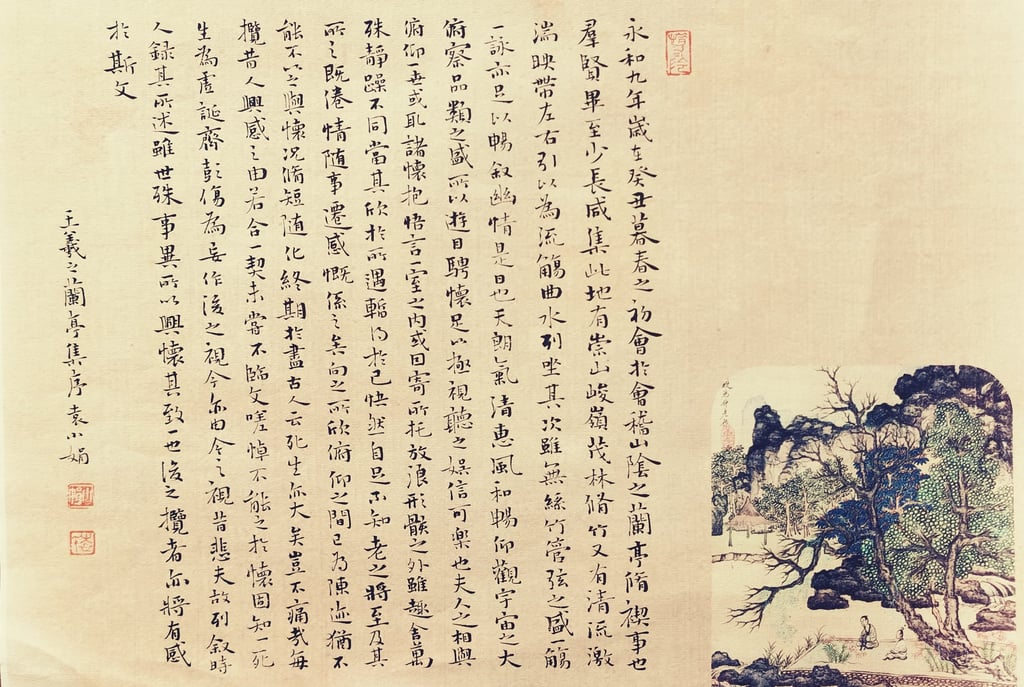
Most people, when they see a piece of calligraphy, see the result.
The ink already dry, the seal already pressed, the work already mounted — hanging quietly as though it had always been there. But before it became "a work", there was a process — unhurried, irreversible, full of quiet ritual — that most viewers have never witnessed.
This article wants to take you into that process, from the first drop of water falling onto the inkstone to the final seal being pressed into place.
Step 1: The Four Treasures of the Study
An authentic calligraphy work is created using four materials which, together, carry a name of their own: the Four Treasures of the Study (文房四宝, wénfáng sìbǎo).
The brush (毛笔, máobǐ) — Made from animal hair: wolf hair, stiff and elastic, for firm and vigorous strokes; goat hair, soft and highly absorbent, for rounded and richly inked marks; or blended hair, with qualities between the two. A calligrapher typically owns several brushes of different sizes and stiffness levels, choosing each one according to the content and scale of the work. A well-made brush, carefully cleaned and hung to dry after each use, can accompany its owner for years.
The ink (墨, mò) — Traditional ink is made from pine soot or oil soot, bound with animal glue and compressed into a solid stick — the ink stick (墨锭, mòdìng). Good ink, when ground, produces a deep black with tonal layers that does not fade when dry. The finest ink sticks are objects of beauty in themselves, often carved with decorative motifs or inscriptions, and develop a subtle fragrance after years of storage. Modern calligraphers also use bottled ink, though for significant works many still prefer to grind their own.
The inkstone (砚台, yàntái) — A stone implement for grinding and holding ink, consisting of a grinding surface and a shallow well. The Duan inkstones (端砚, from Zhaoqing, Guangdong) and She inkstones (歙砚, from Shexian, Anhui) are the most celebrated: their fine texture releases ink smoothly without damaging the brush. A fine inkstone is not merely a tool — it is an object of quiet contemplation on the scholar's desk, and some are of considerable value.
Xuan paper (宣纸, xuānzhǐ) — Made from the bark of the green sandalwood tree and rice straw, produced in Jing County, Anhui Province, xuan paper is the most important surface for Chinese calligraphy and painting. What makes it unique is its absorbency: the moment a brush touches it, ink filters and spreads along the fibres in a way that creates a softly defined line impossible to replicate on any other paper. A work on properly stored xuan paper can survive intact for centuries — the Tang dynasty calligraphy preserved in the Palace Museum remains perfectly legible today.
Step 2: Grinding the Ink — stillness before creation
If an ink stick is used, the first act is grinding.
A few drops of clean water are added to the well of the inkstone, and the ink stick is rubbed in slow, steady circles against the grinding surface. The ratio of water to ink, the pressure, and the speed of the grinding all affect the final consistency. Ink that is too thin will bleed uncontrollably on the absorbent xuan paper; ink that is too thick will drag and lose its fluid quality. An experienced calligrapher knows by touch and sight alone when the ink has reached exactly the right consistency.
Grinding ink is slow. Ten minutes at least, sometimes more. But that slowness has a purpose.
As the hands move, the mind quiets. Scattered thoughts gradually settle; attention begins to gather around what lies immediately ahead. By the time the ink is ready, the inner state for creating is ready too. The classical phrase for this is 凝神静气 (níngshén jìngqì): "the spirit concentrated, the breath stilled". Grinding ink is the most natural vehicle for arriving at that state.
Even calligraphers who use bottled ink will often observe a period of stillness or quiet contemplation before picking up the brush. The effect is similar; only the visible ritual is absent.
Step 3: Preparing the Paper and the Mind — the intention precedes the brush
The xuan paper is laid flat on a felt mat, smooth and unwrinkled. The slight give of the felt makes the brush's contact with the paper more responsive and comfortable.
Then the calligrapher begins to "see" the blank page.
How many columns? What size will the characters be? How much space between them? Where will the inscription go? Where will the seal be placed? All these questions must have answers in the mind before the first stroke falls.
There is a classical principle in Chinese calligraphy: 意在笔先 (yì zài bǐ xiān) — "the intention precedes the brush". Before writing, the entire composition must already exist in the mind. No pencil sketch, no guide lines, no trial strokes. The blank paper is the final battlefield; the calligrapher has only one chance.
This quality of irreversibility gives the creative act a singular tension: one must arrive with a clear vision, yet remain completely free and present in the moment of each stroke. Too much calculation kills the vitality of the characters; too much impulse leaves them without structure. The subtle balance between the two is what the calligrapher pursues across an entire lifetime.
Step 4: Writing — the unrepeatable moment
The brush is loaded with ink, the wrist is raised, and the calligrapher begins to write.
The correct posture holds the brush handle perpendicular to the paper, with movement generated by the wrist, forearm and even the full arm — not merely the fingers. For large-format works, the calligrapher stands, the whole body engaged; for smaller works one may sit, but the arm remains free, never resting on the paper.
Each stroke has its defined technique: the entry (入笔), the movement (行笔), and the close (收笔). Take the horizontal stroke in regular script as an example: it begins with a slight press upward and to the right, then travels horizontally, and ends by drawing the brush back down and to the left. The entire movement takes fractions of a second, yet contains three distinct, conscious decisions. This fine-grained control over every stroke is something the calligrapher internalises over years — or decades — of practice.
As writing proceeds, the ink on the brush gradually diminishes. At the start, strokes are dense and fully saturated; as the work progresses, the black lightens, and in some strokes a faint flash of white paper appears through the line. This is called 飞白 (fēibái, "flying white"), and it is not a flaw but a form of expressive brushwork. An experienced calligrapher uses this natural fluctuation between wet and dry consciously, creating rhythm and tonal depth throughout the composition.
This irreversibility makes every calligraphy work an authentic record of the calligrapher at a specific moment in time: the state of that day, the feeling of that instant — all of it fixed in the traces of ink on the page.
Step 5: The Inscription — the work introducing itself
Once the main body is complete, the calligrapher adds the inscription (题款, tíkuǎn) in smaller characters, in the appropriate position within the composition.
The inscription typically includes:
The content written (the title of the poem or the source of the text)
For whom it was made (if a gift or commission)
The date of creation (in the traditional Chinese sexagenary calendar, sometimes with the season or solar term noted)
The calligrapher's name (or courtesy name or literary pseudonym)
The style of the inscription is usually more relaxed than that of the main body — often running script or even cursive — creating a quiet dialogue within the work. The main body is the formal statement; the inscription is the calligrapher's own voice.
To read a calligraphy work without reading the inscription is to see only half of it. The inscription tells you where the work came from and why it was made. It transforms "some characters" into "characters with a history".
Step 6: The Seal — the final settling
After the inscription, the seal.
The calligrapher takes one or more carved stone seals — typically a name seal (姓名印) and a studio seal (斋号印), sometimes also a phrase seal with a personal motto — presses them evenly into the vermilion paste (朱砂印泥) and stamps them firmly and steadily in the position chosen. The pressure must be even; any movement during the stamping will blur the carved text.
The placement of the seal is considered carefully. The name seal is placed after the signature; the studio seal or phrase seal is positioned according to the compositional needs of the work — in a corner, or as an accent — contributing to the final visual balance of blacks, whites, and empty spaces across the whole piece.
The contrast between the vermilion red of the seal, the black ink, and the white paper is the most recognisable chromatic relationship in Chinese calligraphy and painting. In the moment the seal falls, the work is truly complete — it is the calligrapher's signature, their mark, the last breath of the piece.
After the brush: drying and mounting
A freshly completed calligraphy work must dry fully before it can be moved or rolled. Xuan paper, saturated with wet ink, is soft and fragile; ink that has not dried can smear. There is no rushing this.
Once dry, the work is usually sent for mounting (装裱, zhuāngbiǎo) — a specialist craft in which the calligraphy is adhered to a backing paper, bordered with silk or brocade, and presented as a hanging scroll, album leaf, or framed piece. Proper mounting does not merely enhance the work's appearance; it physically protects the xuan paper and extends its lifespan significantly. It is precisely thanks to successive rounds of careful conservation and mounting over the centuries that so many works from the Tang and Song dynasties have survived to the present day.
From the first drop of water on the inkstone to the final seal pressed into place, the birth of a calligraphy work may take serveral hours or several days.
But what happens during that time goes far beyond "writing". It is one person in full concentration, in simultaneous dialogue with themselves, with the words, with the materials, and with an entire tradition.
When you receive an original calligraphy work, you do not receive merely a page with characters. You receive all the attention deposited in that process, every present and unrepeatable moment — and behind it all, the weight of a tradition practised and refined across more than two thousand years, condensed into a few strokes of ink.
Browse Yuan Xiaojuan's original calligraphy artworks →
All artworks at VivaTinta are originals created by Yuan Xiaojuan using traditional xuan paper, natural ink, and hand-carved stone seals. Yuan Xiaojuan is an official member of the China Calligraphers Association, working in the authentic classical tradition.