The Return (归去来兮辞)
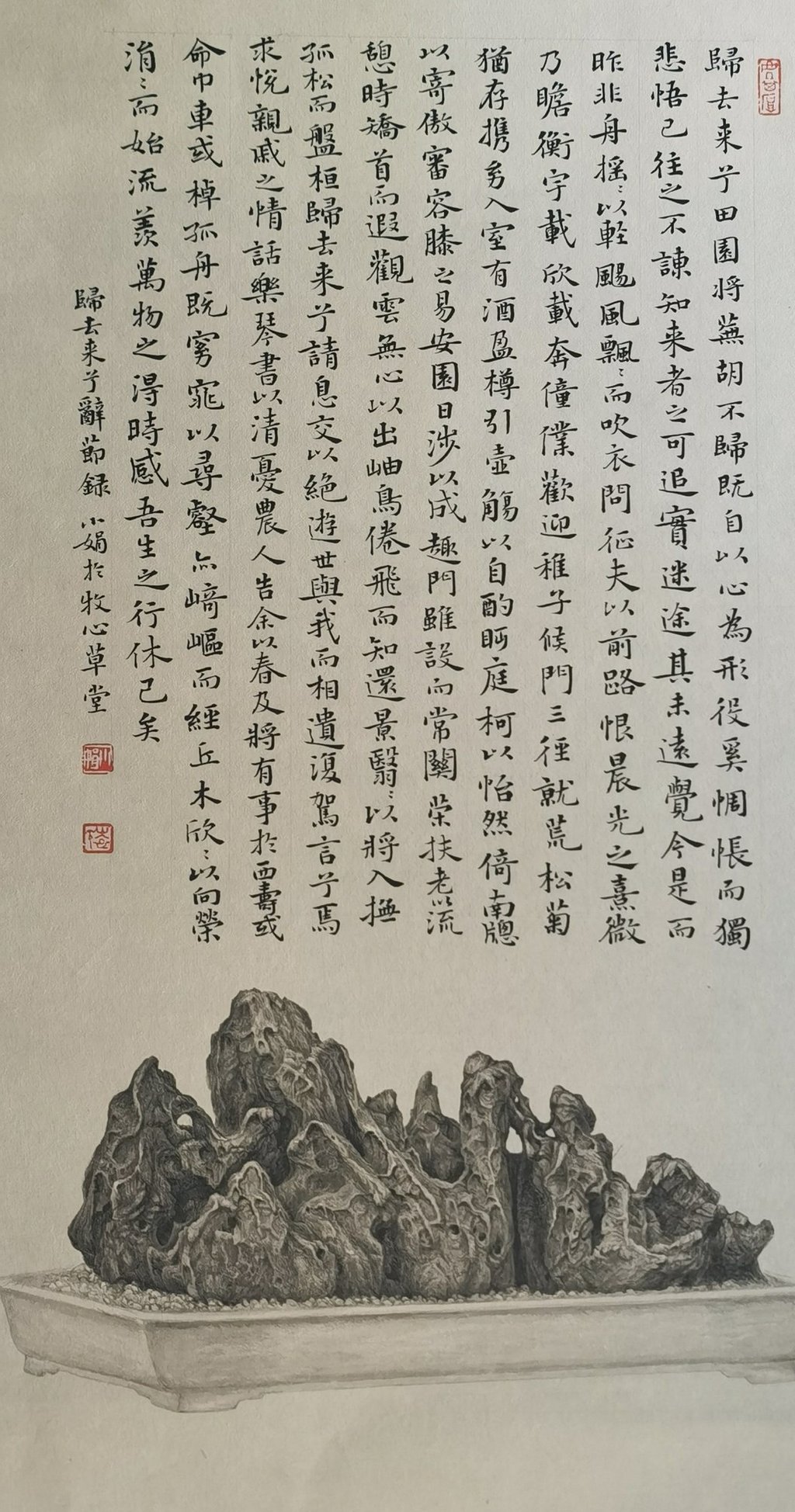
Original Chinese calligraphy of Tao Yuanming's "The Return", a timeless ode to homecoming and inner freedom. Hand-written, signed and sealed by Yuan Xiaojuan.
6/21/2026
Artwork Details
Title
"The Return" (归去来兮辞, Guī Qù Lái Xī Cí), abridged excerptCalligrapher
Yuan XiaojuanOriginal author
Tao Yuanming (Tao Qian), Eastern Jin dynasty, c. 365–427 CEScript style
Running-regular script (行楷, xíngkǎi)Paper
Cream-white xuan paperSeals
One red opening seal (upper right); two name seals (at the signature)Studio
Muxin Caotang (牧心草堂, Shepherd's Heart Studio)Accompanying painting
An ink-wash rendering of a scholar's viewing stone, set on a carved wooden stand
The Text in Full
Homeward I go! My fields and garden will soon be overgrown — why not return? Since I have let my mind be enslaved by my body, why should I grieve and lament alone? I understand that what is past cannot be remonstrated, but what is to come may yet be pursued. Truly I have strayed from the path, but not gone far; I now know that today is right and yesterday was wrong. My boat rocks gently, lightly skimming the water; the wind blows softly, fluttering my robes. I ask a traveller how much further the road runs, and resent the faint, lingering light of dawn.
At last I see the eaves of my own house, and rush forward with joy. The servants come out to welcome me; my young children wait at the gate. The three paths through the garden have grown wild, yet the pines and chrysanthemums still stand. I lead the children inside, where wine fills the cup. I pour myself a drink and gaze contentedly at the branches in the courtyard; I lean against the south window and give myself to quiet pride, finding this room — barely large enough for my knees — entirely at ease. Each day I walk in the garden and find new delight in it; though a gate has been set, it stays closed. Leaning on my cane, I wander and rest by turns, sometimes lifting my head to gaze into the distance. The clouds drift effortlessly from the mountain peaks; the birds, weary of flight, know when to return to their nests. As the light begins to dim, I linger, stroking a solitary pine, unwilling to leave.
Homeward I go! Let me cease all worldly engagements and outings. The world and I have grown apart — why drive out again, and to what end? What brings me joy is the warmth of conversation with kin, and the music and books that dispel my cares. The farmers tell me spring has arrived, and there is work to be done in the western fields. Sometimes I take a curtained cart, sometimes I row a solitary boat — seeking out hidden ravines, or crossing rugged hills. The trees grow lush and flourishing; the springs begin to trickle and flow. I envy all things their proper season, and feel my own life moving steadily toward its end. So be it…
Colophon: Excerpt from "The Return" · Yuan Xiaojuan, written at Muxin Caotang
Reading the Text
"The Return" was written by Tao Yuanming upon resigning from official life, and consists of a preface followed by the main rhapsody. This work transcribes the central body of the text — a record of a homecoming that is at once physical and spiritual.
The opening — a decision made
"Homeward I go! My fields and garden will soon be overgrown — why not return?" The poem opens as a call to action. Tao Yuanming then names the root of his resignation: "Since I have let my mind be enslaved by my body, why should I grieve and lament alone?" Having allowed his inner life to be governed by an official post and its stipend, why mourn it any longer? He arrives at clarity: "What is past cannot be remonstrated, but what is to come may yet be pursued." The road taken cannot be undone — but the road ahead remains open. "I have strayed from the path, but not gone far; I now know that today is right and yesterday was wrong" — he is relieved that his error has not carried him too far astray, and recognises, at last, that his present choice is correct, and his former service was a mistake.
The journey home — lightness
The boat rocks gently on the water; the wind lifts and flutters his robes. He asks a passerby how much farther the road runs, resenting only that the dawn light is too faint, too slow — these lines capture the breathless eagerness of homecoming with extraordinary lightness and immediacy.
Arrival — the warmth of family
Seeing the eaves of his house in the distance, Tao Yuanming runs forward in a mixture of astonishment and joy. The household servants welcome him; his young children wait at the gate. The garden paths have grown wild with neglect, yet the pine trees and chrysanthemums still stand firm — a quiet symbol of his own character: though long untended, his proud integrity has never wavered. Leading the children inside, he finds the wine cup already filled, and pours himself a drink, gazing with contentment at the courtyard trees. Leaning against the south window, he gives himself over to a sense of quiet pride; surveying his modest room — barely large enough for his knees — he finds it entirely at ease. This is the Taoist wisdom of "less is more, more is confusion" made vivid and personal.
Garden life — leisure
He walks the garden each day, finding endless delight in it; the gate, though installed, remains closed — he has no further use for worldly comings and goings. Leaning on his cane, he wanders and pauses, occasionally lifting his head to gaze at the distant view. "The clouds drift effortlessly from the mountain peaks; the birds, weary of flight, know when to return to their nests" — these two lines are the most philosophically resonant in the entire piece: clouds emerge from the hills with no calculation at all; birds, tired from flying, instinctively know to come home. This is both a description of the scene and a self-portrait — Tao Yuanming's retirement, like the cloud's emergence or the bird's return, is a natural unfolding of his true nature, not a deliberate performance of virtue. As dusk gathers, he lingers, stroking a solitary pine tree, reluctant to leave.
The second "Homeward I go!" — fellowship and farming
Tao Yuanming calls out "Homeward I go!" a second time — this time, resolving to cease all worldly engagements. The world and his own inclinations have grown apart; what use is there in setting out again? What truly brings him joy is the warmth of conversation with family, and music and books to dispel his worries. The farmers tell him spring has come, and the western fields await ploughing. He travels sometimes by curtained cart, sometimes by a solitary boat, seeking out secluded ravines or crossing rugged hills. The trees grow lush and thriving; the springs begin their gentle flow. All things find their proper season and flourish — and this fills him with both admiration and a quiet awareness that his own life, too, moves steadily toward its close.
The text breaks off at "So be it…" — a clear mark of the abridgement. In the complete original, this is followed by a more philosophical closing passage, beginning "So be it indeed! How much longer shall this body dwell within the universe? Why not let the heart decide, freely, whether to stay or go" — a meditation on mortality and the acceptance of one's fate. This excerpt, by contrast, captures precisely the most vivid, most warmly human portion of the text: the joy of homecoming, the comfort of family, the leisure of rural life — leaving the philosophy unspoken, and the texture of lived experience for the reader to savour.
Cultural Background: Tao Yuanming and "Not Bowing for Five Pecks of Rice"
Tao Yuanming (c. 365–427 CE), courtesy name Yuanliang, was a poet of the Eastern Jin dynasty, revered by later generations as the father of Chinese pastoral poetry.
In 405 CE, Tao Yuanming took up the post of magistrate of Pengze County. After barely eighty days in office, he resigned — refusing, as the famous account goes, "to bow for five pecks of rice": refusing to humble himself before a superior official in exchange for a meagre stipend. He never returned to official life again. "The Return" was written on the very day of his resignation, recording this decisive turning point.
This essay holds an extraordinary place in Chinese literary history. It is not merely a resignation letter — it became a foundational monument in the spiritual history of Chinese letters, establishing an ideal of character that has endured for over a millennium: better to live in modest poverty with integrity intact than to compromise one's true heart for wealth and position. Ever since, the phrase "Homeward I go" (归去来兮) has served as the most frequently invoked touchstone for Chinese scholars facing the conflict between worldly office and inner truth.
Su Shi himself once wrote that in matters of public service and withdrawal, he had "never failed to take Yuanming as my teacher" — a testament to how deeply Tao Yuanming's example shaped the generations of literati who followed him.
About the Script: The Ease of Running-Regular Script
This work is written in running-regular script (行楷, xíngkǎi) — fluent and natural in its strokes, clear and upright in structure, perfectly suited to a text that holds both philosophical depth and the warm texture of everyday life.
Looking closely at this work:
Brushwork: The strokes move at an unhurried pace; the rhythm of pressing and lifting carries a quality of relaxed self-possession that echoes the text's own images — "my boat rocks gently, lightly skimming the water," "sometimes lifting my head to gaze into the distance."
Composition: Arranged in vertical columns with even, spacious intervals, the whole flows without a single cramped or hurried passage — much like the inner world Tao Yuanming describes, where a room "barely large enough for my knees" is, nonetheless, entirely at ease. Space may be small; the spirit remains wide.
Spirit: The work as a whole radiates a quality of calm, ease, and unhurried contentment — as though the calligrapher herself, brushstroke by brushstroke, undertook her own small homecoming in the writing of it.
The Accompanying Painting: A Scholar's Viewing Stone
Below the text is painted a viewing stone (奇石), rendered in ink wash and set upon a carved wooden stand — its jagged, weathered form suggesting a miniature mountain range.
This is one of the most representative objects of the traditional Chinese scholar's studio: the gongshi, or "presentation stone," sometimes called a "landscape for the desk." A scholar could not always retreat into the mountains and forests, so he kept a single extraordinary stone upon his desk — "a fist standing in for a mountain, a ladle standing in for a river" — concentrating, within the span of a few inches, his longing for nature. This tradition dates back at least to the Tang and Song dynasties, and shares the same spirit of withdrawal that Tao Yuanming represents.
Placing the stone painting alongside "The Return" creates a resonant pairing: the text recounts an actual journey of withdrawal from public life, while the painted stone is the same spirit of retreat, made permanent upon a scholar's desk. Even when one cannot dwell among mountains and forests every day, a single ridge and valley may still keep one company within the heart.
For the Collector
"The Return" is the most important "declaration of withdrawal" in the history of Chinese literature. The phrase guī qù lái xī — "homeward I go" — carries within it the longing for spiritual freedom that Chinese scholars have held for well over a thousand years.
The value of this work lies on three levels:
Literary — the foundational work of the Chinese pastoral tradition, founded by Tao Yuanming himself; its lines describing clouds emerging from the hills and birds returning to roost remain among the most celebrated expressions in Chinese literature of nature and inner character becoming one; Calligraphic — the running-regular script unfolds with unhurried ease, the brushwork and the text's own spirit perfectly aligned — a true example of "the writing as the text, the text as the person"; Spiritual — it tells of a choice that remains as relevant now as it was sixteen centuries ago: how, caught between material security and the integrity of one's own heart, between worldly obligation and freedom, a person might find their own way home — a path where "today is right and yesterday was wrong." For anyone living within the speed of modern life, this choice still speaks directly.
Hang this work in your home, and the text on the wall — together with the solitary stone upon your desk — will, time and again, offer the same simple reminder: the fields and gardens need not lie far away. To go home can also be a choice made here, now, today.
Yuan Xiaojuan is an official member of the China Calligraphers Association and President of the Weihai Calligraphers Association. This work was created at Muxin Caotang, hand-brushed on traditional xuan paper with natural ink, bearing the calligrapher's personal seals. One of a kind.