Artwork Notes · Charm of a Maiden Singer: Meditation on the Past at Red Cliff (念奴娇·赤壁怀古)
6/16/20266 min read
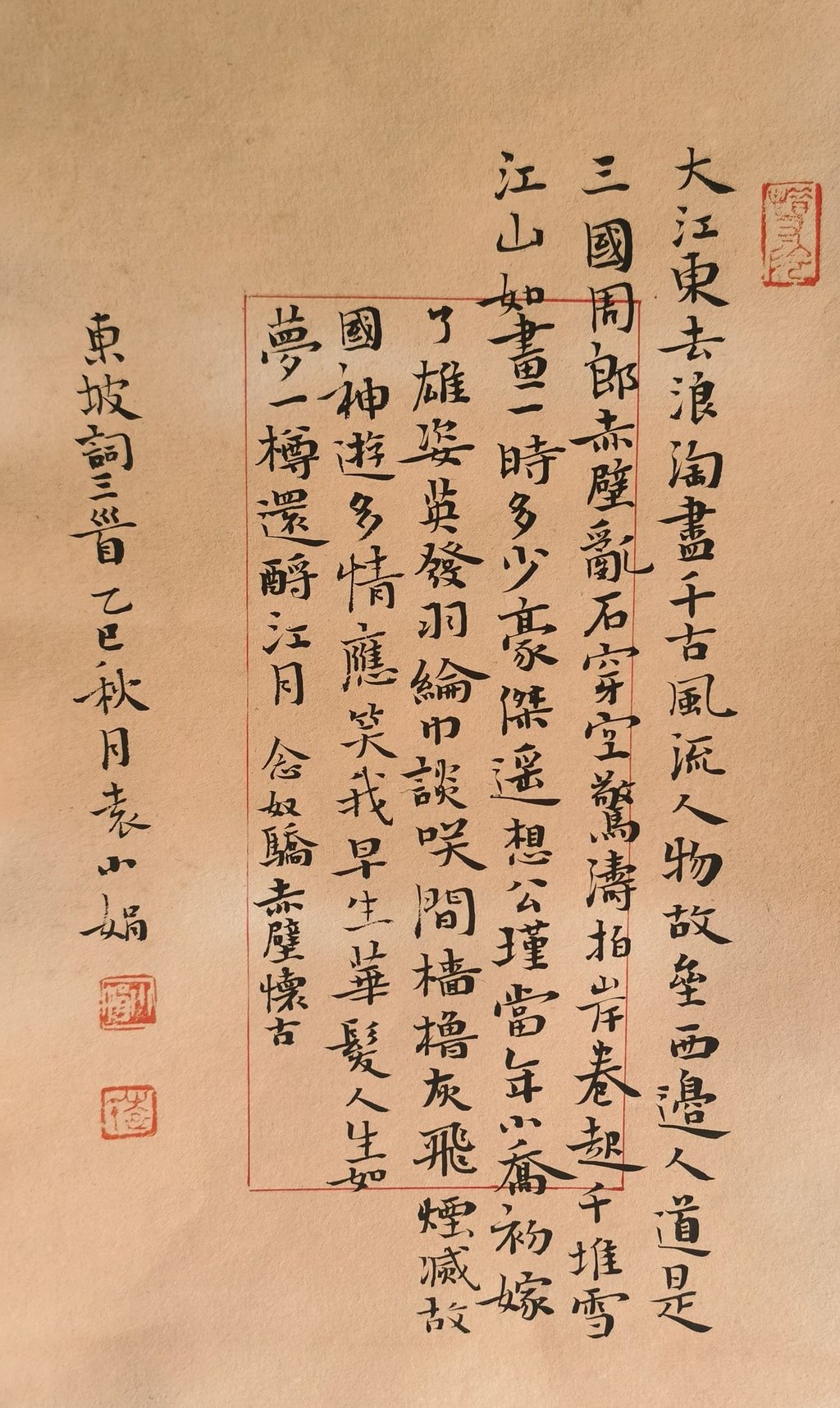
Artwork Details
Title
Charm of a Maiden Singer: Meditation on the Past at Red Cliff (念奴娇·赤壁怀古)
Calligrapher
Yuan Xiaojuan
Original author
Su Shi (sobriquet Dongpo), Northern Song dynasty, 1037–1101 CE
Script style
Running-regular script (行楷, xíngkǎi)
Dated
Autumn of the Yisi year (autumn 2025)
Paper
Antique brown xuan paper
Seals
One opening seal (upper right); two name seals (at the signature, lower left)
The Text in Full
The great river flows east, its waves washing away / the gallant figures of a thousand ages. / West of the ancient rampart, people say, / lies the Red Cliff of Zhou Yu of the Three Kingdoms. / Jagged rocks pierce the sky, / fierce waves pound the shore, / rolling up a thousand drifts of snow. / The land is like a painting — / how many heroes once gathered here at one time! /
My thoughts travel back to Gongjin in those years, / when the fair Xiao Qiao had newly become his bride, / his bearing valiant and bright. / Feather fan in hand, silk kerchief on his head, / amid talk and laughter, / masts and oars vanished into flying ash and smoke. / My spirit wanders through that ancient kingdom — / sentimental as I am, well might they laugh at me, / my hair turned grey so soon. / Life is like a dream; / let me pour a cup of wine as libation to the river moon.
Reading the Poem
"Charm of a Maiden Singer: Meditation on the Past at Red Cliff" is the supreme achievement of Su Shi's "bold and unrestrained" ci, and one of the most magnificent works in the entire history of Chinese ci poetry. It falls into two stanzas:
The first stanza: the scene — the grandeur of Red Cliff
It opens: "The great river flows east, its waves washing away the gallant figures of a thousand ages." In a single line, the reader is swept into the vast current of history — the Yangtze rolls eastward, carrying away countless heroes of a thousand years. The poet arrives at the legendary site of the Battle of Red Cliff from the Three Kingdoms era, before a scene of magnificence: "Jagged rocks pierce the sky, fierce waves pound the shore, rolling up a thousand drifts of snow." Sheer cliffs thrust into the heavens; surging waves crash against the bank, throwing up ten thousand crests of snow-white foam. "The land is like a painting — how many heroes once gathered here at one time!"
The second stanza: meditation — Zhou Yu and the self
The second stanza turns to the memory of a historical figure. Su Shi recalls the young general Zhou Yu (courtesy name Gongjin): in those days he had just married the beauty Xiao Qiao, in the prime of his spirited youth. Amid talk and laughter, feather fan waving, silk kerchief on his head, he calmly commanded the battle that sent Cao Cao's warships "into flying ash and smoke" — the great fire of Red Cliff, and what dashing triumph it was.
Then the tone shifts, and the poet returns to the present: "Sentimental as I am, well might they laugh at me, my hair turned grey so soon." He ends with: "Life is like a dream; let me pour a cup of wine as libation to the river moon." Life is but a single great dream — so let me raise my cup, and pour this wine out to the bright moon upon the river.
From admiration of the hero, to lament over his own circumstances, to a final, expansive serenity — Su Shi fuses grandeur with melancholy, ambition with disappointment, in a single crucible. This is the distinctive realm of "Dongpo's ci."
Cultural Background: Su Shi and the Bold School of Ci
Su Shi (1037–1101 CE), courtesy name Zizhan, sobriquet Dongpo Jushi (the Recluse of the Eastern Slope), was a rare universal genius in the history of Chinese culture — accomplished in poetry, ci, prose, calligraphy, and painting alike. In literature, he was one of the "Eight Masters of the Tang and Song"; in calligraphy, he ranked first among the "Four Masters of the Song"; and in the realm of ci, he was the founding master of the bold and unrestrained school (豪放派).
Before Su Shi, ci poetry largely concerned the feelings of the heart, the sorrows of parting — tender and delicate in style. Su Shi expanded the subject matter of ci to landscape, history, life, and philosophy, lending it a grandeur it had never known. "Meditation on the Past at Red Cliff" is the landmark work of this transformation — proof that ci could express not only "the dawn wind and the waning moon by the willow bank," but also the soaring heroism of "the great river flowing east."
The Context of Its Writing This poem was written in 1082 CE, during Su Shi's exile to Huangzhou following the "Crow Terrace Poetry Trial." It was a low point in his life — politically out of favour, far from the imperial court. Yet it was precisely during these years at Huangzhou that he wrote "Meditation on the Past at Red Cliff," the "Rhapsodies on the Red Cliff," and other timeless masterpieces. Faced with disappointment, Su Shi did not sink into despair; instead, before the grandeur of the Yangtze and the Red Cliff, he came to a profound understanding of life's expansiveness and transcendence. This spirit — remaining magnificent of heart even in adversity — is what later generations have most admired in him.
About the Script: The Strength of Running-Regular Script
This work is written in running-regular script (行楷, xíngkǎi) — combining the dignity of regular script with the fluency of running script, perfectly echoing the poem's quality of "boldness with steadiness."
A bold poem demands a matching strength of brush. Looking closely at this work:
Brushwork: The strokes are weighty and forceful, with decisive beginnings and endings and structural strength at the turns. Occasional connecting threads between strokes lend a spirit of grandeur within the orderliness — a fitting match for the magnificent momentum of "the great river flows east."
Composition: The main text is bordered by a vermilion frame, the classic format of the traditional Chinese album leaf and letter paper. The red frame against the black characters and brown paper creates a contrast both dignified and striking; within the ruled grid, every character stands firm, the whole unified in spirit.
Spirit: The work radiates an atmosphere of deep, expansive grandeur. The calligrapher commands this magnificent poem with a steady running-regular hand, the strength of the brush and the spirit of the poem completing one another — to read these characters is to hear the river's waves pounding the shore.
The Arrangement of Seals An opening seal (起首印) is stamped at the upper right of the work, with two name seals at the signature in the lower left. This complete arrangement — opening seal, main text, signature, and name seals — reflects the formal and meticulous conventions of traditional calligraphy.
For the Collector
"The great river flows east, its waves washing away the gallant figures of a thousand ages" — this is a line known to every Chinese person. The place of "Meditation on the Past at Red Cliff" in Chinese culture needs no further explanation. It is the representative work of the bold school of ci, the very embodiment of Su Shi's spirit, and a portrait of the grandeur and expansiveness that lie deep in the Chinese heart when facing the rises and falls of life.
The value of this work lies on three levels:
Literary — the most renowned representative work of the bold school in the history of Chinese ci, of the highest cultural recognition; the phrase "the great river flows east" is almost synonymous with the Chinese spirit of heroic grandeur; Calligraphic — a long, bold poem rendered in running-regular script, uniting strength of brush with grandeur of spirit; together with the traditional album-leaf format of its vermilion frame, it is a work complete in form and magnificent in atmosphere; Spiritual — it conveys a vision of life that "remains expansive after every disappointment." The heroism Su Shi wrote in the depths of exile reaches across nearly a thousand years, and can still give strength to people today.
Hang this work in your home, and the verses of "Charm of a Maiden Singer" on the wall become the rushing of the Yangtze, the smoke of battle at Red Cliff, the dash and grace of Zhou Yu — and, above all, the serenity and release of Su Shi's closing line: "Life is like a dream; let me pour a cup of wine as libation to the river moon." In the fast pace of modern life, it reminds us that the rises and falls of life are the natural order of things, and that only a heart kept open can smile before the river moon.
Yuan Xiaojuan is an official member of the China Calligraphers Association and President of the Weihai Calligraphers Association. This is an original work, hand-brushed on traditional xuan paper with natural ink, bearing the calligrapher's personal seals. One of a kind.
Brand
Explore our sleek website template for seamless navigation.
Contact
Newsletter
© 2024. All rights reserved.
Terms and Conditions